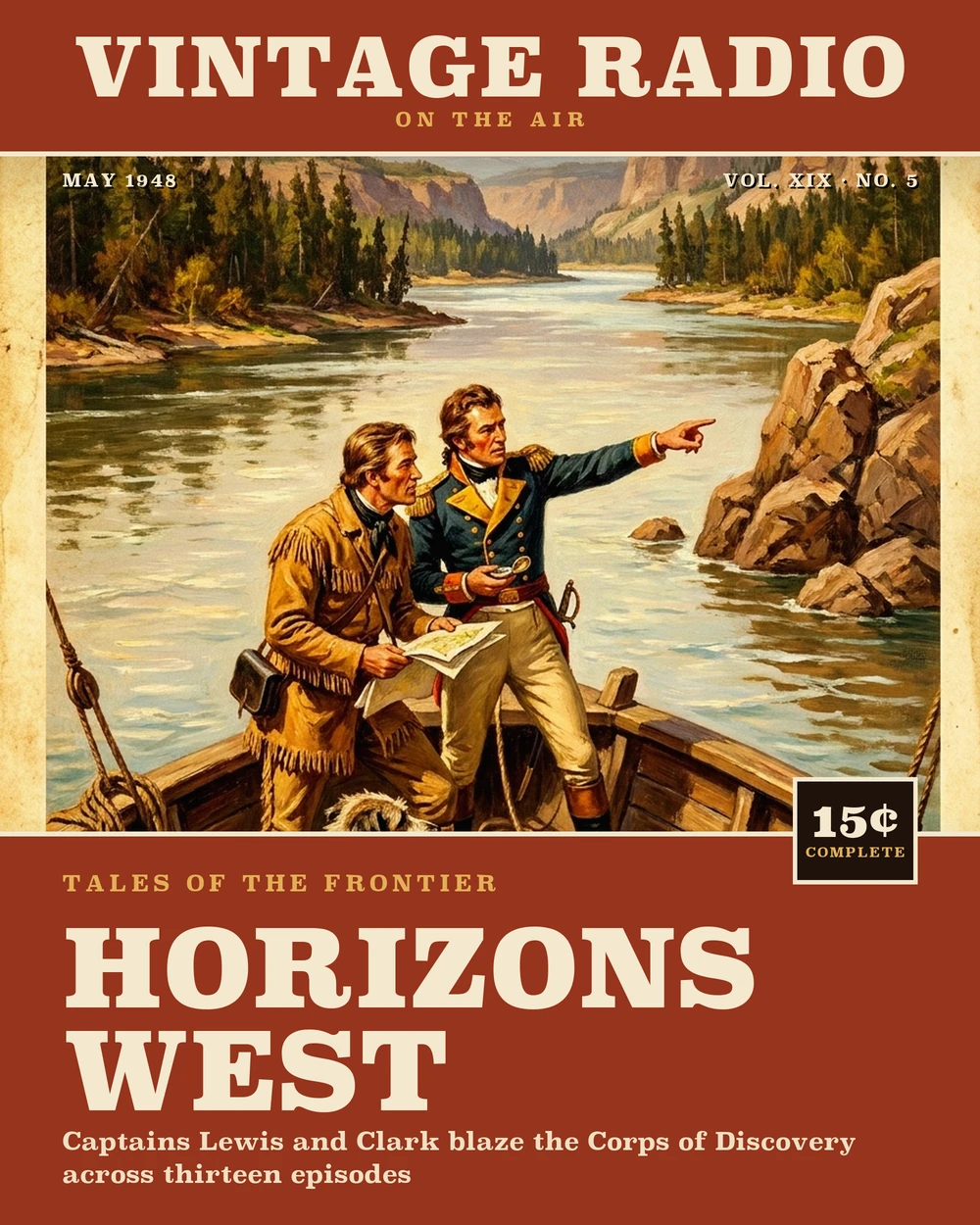
Horizons West
Not Cowboys — Captains
Horizons West sits in the Western category, but it doesn't fit the usual mold. There are no sheriffs, no outlaws, no saloon shootouts. The show is a thirteen-episode historical docudrama tracing the Lewis and Clark Expedition from 1803 to 1806 — President Jefferson's plan to send two Army captains west from St. Louis all the way to the Pacific Ocean. It's the frontier, all right, but the drama comes from rivers, mountain ranges, hostile encounters, and the sheer scale of what the Corps of Discovery was attempting. Programs like Cavalcade of America and You Are There are the natural company it keeps, not Gunsmoke or Cisco Kid.
The series was produced at Capitol Records Studio in Hollywood in 1962–63 and broadcast on the Armed Forces Korea Network and the Far East Network in 1965–66. Episode air dates run from November 14, 1965 to January 23, 1966, putting the show squarely in front of an audience of American servicemen stationed overseas. That audience shapes everything about how the series was made: it's serious, it's patriotic in the deepest sense, and it trusts its listeners to follow a genuine historical narrative over thirteen half-hour installments.
The Scripts and the Sound
The scripts were written by William Tundberg and Carl A. Tundberg, with William Lally producing. The writing follows the actual arc of the expedition episode by episode, which gives the series a cumulative weight that single-story Westerns rarely achieve. By the time the corps reaches the Pacific in "To the Pacific" or turns back east in "Homeward Bound," the listener has traveled the whole distance with Lewis and Clark.
Each episode runs roughly thirty minutes, making the full series just over six and a half hours of drama. The production used sound effects and musical scoring to evoke the landscape and weather the expedition actually faced — river crossings, mountain cold, open prairie. Gene Twombley composed the score, and exit music for episodes was drawn from "Roundup on the Prairie" by Aaron Kenny. The combination of period-appropriate drama, location-evoking sound design, and that underlying score gives the series a consistent atmosphere across all thirteen episodes.
The subject matter demanded that kind of consistency. An episode like "Dakota Winter" or "Shoshone Country" only works if the listener already believes in the world the production has built. The Tundbergs' scripts earn that belief by following the real landmarks — the Great Falls of Montana, the Columbia River, encounters with the Teton Sioux, the Blackfoot war party in "Lewis and the Blackfeet" — rather than inventing fictional adventure to fill the running time.
The Two Captains
Harry Bartell played Captain Meriwether Lewis across all thirteen episodes. Bartell — sometimes credited as Harry Bartel — was born November 28, 1913, and by the time Horizons West was produced he had appeared in roughly 185 radio series, making him one of the most experienced West Coast character actors working in the medium. He brought that depth to a role that required consistency and authority over a long dramatic arc rather than a single star turn.
John Anderson played Captain William Clark. Born October 20, 1922, Anderson held a master's degree in drama from the University of Iowa and built a career — eventually running to more than 500 television roles — playing rugged, authoritative figures. Clark, as a character, needs to feel like someone genuinely capable of leading an expedition into unmapped territory, and Anderson's background in that kind of role served the show well. The pairing of Bartell and Anderson gives Horizons West two lead performances that hold up across the full run without wearing thin.
The supporting cast was substantial. Karl Swensen, Dal McKennon, Don Diamond, Sebastian Cabot, Helen Gerald, Bill Quinn, and Eddie Firestone all appear in recurring roles across the series. That depth of casting matters in a docudrama with a large ensemble — the Corps of Discovery had more than thirty members, plus the various figures the expedition encountered, from Sacajawea to the Teton Sioux leaders to the Blackfoot war party.
What the Episodes Cover
The first episode, "Mr. Jefferson's Dream," aired November 14, 1965, and lays out the full premise: Jefferson's goal of having Lewis and Clark trace the Missouri River from St. Louis to the Great Falls of Montana and beyond to the Pacific. It introduces the main characters, including a large mongrel dog named Shannon who travels with the corps.
From there the series follows the actual sequence of the expedition. Story lines include the corps's first desertion, Sacajawea joining the Corps of Discovery, the confrontation with the Teton Sioux, horse thieves on the Yellowstone River, and the violent encounter with a Blackfoot war party in "Lewis and the Blackfeet." The final two episodes to air were "Homeward Bound" on January 16, 1966, and "Clark and the Horse Thieves" on January 23, 1966, closing out the broadcast run.
The episode titles themselves read like a map of the journey: "Into the Unknown," "The Great Falls," "Shoshone Country," "Fort on the Columbia," "To the Pacific." Thirteen episodes isn't much real estate for three years of historical events, but the Tundbergs chose wisely — each installment covers a distinct phase or crisis, so the series moves without feeling rushed.
Made for Servicemen Abroad
The Armed Forces Radio context is worth understanding. The Armed Forces Radio & Television Service produced programming specifically for American military personnel stationed overseas, and Horizons West was recorded at Capitol Records Studio in Hollywood for exactly that purpose. It reached listeners on the Armed Forces Korea Network and the Far East Network in late 1965 and into early 1966.
That production context explains some of the show's character. It's historically grounded rather than sensationalized. The recurring themes — honor, bravery, the conflict between good and evil — fit naturally into the subject matter of the Lewis and Clark Expedition, and they would have resonated specifically with a military audience. There's nothing accidental about the casting of two Army captains as the heroes of an Armed Forces Radio series.
The full thirteen episodes survive, giving the complete dramatic arc the Tundbergs built — from Jefferson's commission in "Mr. Jefferson's Dream" to the corps's return in "Homeward Bound." That completeness is relatively rare for a series of this vintage and this narrow an original broadcast window.